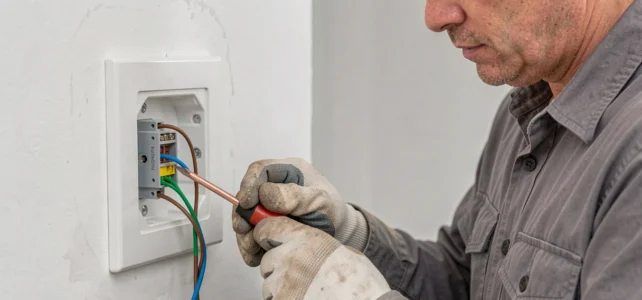
Connecting a Legrand push button to a lighting circuit controlled by a relay requires correctly connecting two wires to the mechanism. The difficulty does not lie in the action (two terminals, two conductors), but in reliably identifying each wire according to the color code imposed by the NF C 15-100 standard. A misidentification between the phase, neutral, or lamp return can cause a short circuit or prevent the relay from switching.
NF C 15-100 standard version 2024: what changes for the push button circuit
Most wiring guides refer to the NF C 15-100 without specifying which edition it is. A new series approved on August 21, 2024 replaces the December 2002 version and its amendments, which will no longer be valid after August 31, 2025.
Since April 1, 2026, this 2024 edition serves as the unique reference for Consuel for the acceptance of new or fully renovated installations. The connection of a Legrand push button remains the same in principle, but compliance is now assessed on the entire circuit: a minimum cross-section of 1.5 mm² for lighting, the presence of a ground wire on each circuit, and an appropriately sized circuit breaker.
A correct connection at the mechanism level is therefore not sufficient if the upstream circuit (circuit breaker, wire cross-section, number of lighting points) does not comply with the updated requirements. For more in-depth information, lighting according to travauxsuccess.fr on Maison Pro provides detailed normative requirements.
Colors of electrical wires: correspondence table for a push button
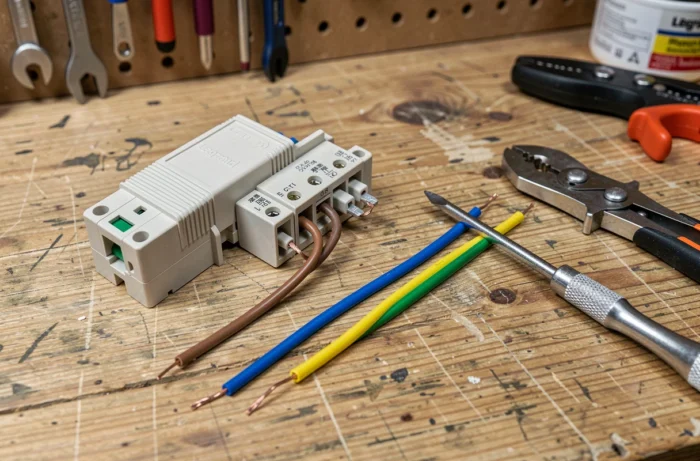
The standardized color code assigns a fixed function to certain conductors, while other colors remain free for specific uses. The table below summarizes the wires you will encounter in a flush-mounted box intended for a Legrand push button connected to a relay.
| Wire Color | Function | Relevant Terminal |
|---|---|---|
| Red (or brown, black) | Phase (incoming from the circuit breaker) | Terminal 1 of the push button |
| Purple, orange, white, or brown | Return to relay coil | Terminal 2 of the push button |
| Blue | Neutral | Not connected to the push button |
| Green/yellow | Ground (protection) | Not connected to the push button |
The phase wire usually arrives in red in recent installations. In homes built before the 1970s, the phase could be gray, black, or even the same color as the neutral, complicating identification.
The return wire to the relay coil adopts a free color (neither blue nor green/yellow). Purple and orange are the most common, but brown or white can also be found.
Why blue and green/yellow never go through the push button
The Legrand push button does not permanently cut any circuit. It sends a pulse to the relay coil via two conductors: the phase and the return to the coil. The neutral (blue) connects directly to the relay in the panel or junction box, without passing through the wall mechanism.
The ground conductor (green/yellow) ensures the protection of metallic masses. On a plastic push button (Céliane, Mosaic, Dooxie ranges), there is no ground terminal on the mechanism. The green/yellow wire remains in the flush-mounted box, connected to the ground terminal of the circuit.
Connection to the terminals of the Legrand push button
Legrand mechanisms (Céliane, Mosaic, Dooxie) have two automatic terminals labeled “1” and “2” or sometimes by the letters engraved on the base. The push button is a momentary contact, not a switch: there is no terminal L like on a two-way switch.
- Terminal 1: connect the phase wire (red, brown, or black depending on the installation) coming from the circuit breaker or another push button in parallel
- Terminal 2: connect the return wire to the coil (purple, orange, white) that goes back to terminal A1 or A2 of the relay in the panel
- If multiple push buttons control the same light point, they are wired in parallel: common phase on all terminal 1s, common return to coil on all terminal 2s
Inserting the wire into the Legrand automatic terminal is done without tools on most recent ranges. Strip the conductor to the length indicated by the template engraved on the mechanism (usually around one centimeter), then push the wire in until it clicks.

Common wiring errors and their consequences
Reversing the phase and return to the coil on the push button does not cause an immediate short circuit, since both wires are live when the circuit is powered. However, connecting the neutral to one terminal of the push button creates a short circuit as soon as pressed, because the phase and neutral come into direct contact through the relay coil.
Another trap: confusing a traveler wire from a two-way switch with a return to the relay coil. In a renovation, it happens that an old two-way switch is replaced by a push button without modifying the upstream wiring. The travelers (often purple or orange) do not serve the same function as a return to the coil, and the circuit will not work.
Check before connecting
Before any intervention, turn off the main circuit breaker. Use a voltage tester (VAT) to confirm the absence of current on each wire. Identify the phase using a test screwdriver or multimeter, then locate the return to the coil by elimination: it is neither blue, nor green/yellow, nor the identified phase.
In older installations where the color code has not been followed, the multimeter remains the only reliable tool. Testing continuity between the suspect wire and terminal A1/A2 of the relay in the panel confirms that it is indeed the return to the coil.
The connection of a Legrand push button involves two wires and two terminals. The real difficulty lies upstream: identifying each conductor with certainty, verifying that the circuit complies with the current NF C 15-100 standard, and never assuming that a color corresponds to a function without having tested it beforehand.