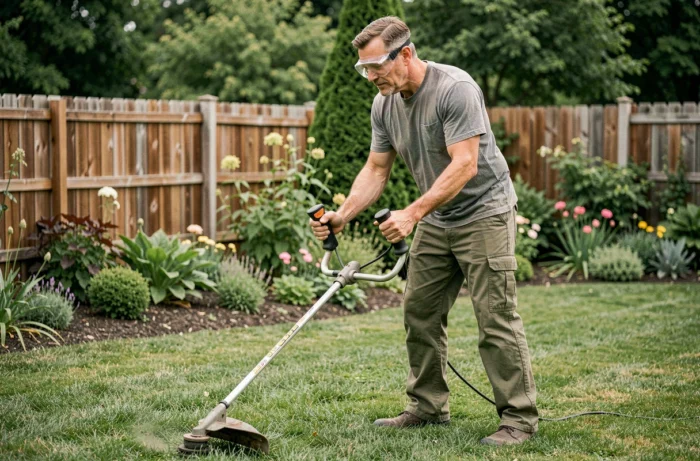
Your lawn is mowed, but a strip of grass still sticks out along the driveway, at the foot of a low wall or around the trees. A string trimmer, also known as a grass trimmer, is designed for exactly this job: cutting grass the mower can’t reach. The key is finding the right model for your garden, vegetation and gardening habits.
Battery, corded or gas-powered: which string trimmer is right for your garden?
The power source affects everything else: weight, noise, freedom of movement and maintenance costs. Before comparing power or brands, start here.
A battery-powered string trimmer is suitable for most small to medium-sized gardens. There’s no cord to unwind, noise levels are moderate and it starts instantly.
The trade-off is battery life: a single charge may not be enough for a large garden. If you already own cordless garden tools from the same brand, check whether the batteries are compatible. Using the same battery for your string trimmer, chainsaw or hedge trimmer can reduce your overall costs.
To find out how to choose the best string trimmer for your garden, power source is the first criterion to consider.
A corded model (plugged into the mains) delivers consistent power with no time limit. It’s often cheaper to buy. Its main drawback is the extension cord. Beyond about 30 metres, the cord becomes an obstacle, especially in a garden with shrubs or flower beds.
A gas-powered string trimmer is designed for very large areas or land overgrown with dense vegetation. It’s heavier and noisier, and its engine needs regular maintenance (spark plug, filter and fuel mixture). For a typical garden in a residential area, it’s rarely the right choice.
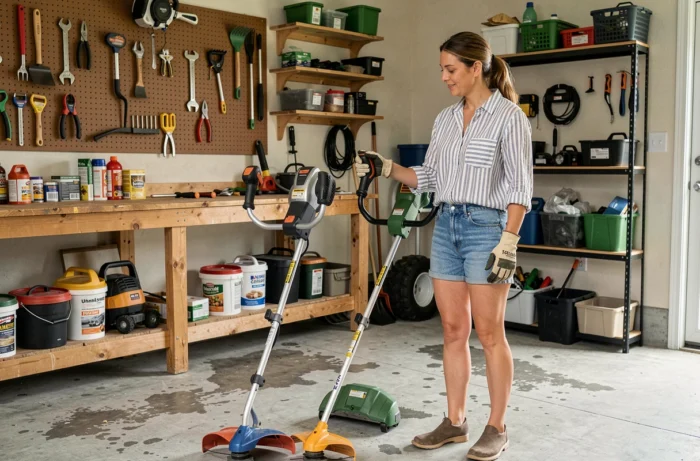
String trimmer cutting heads: nylon line, plastic blades or a metal blade
Have you noticed how some string trimmers cut cleanly on the first pass, while others tear the grass rather than cutting it? The difference often comes down to the cutting head.
Nylon line: the most common option
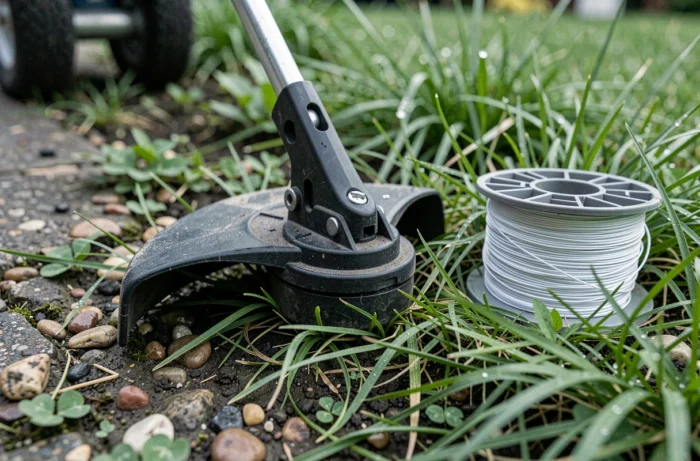
Nylon line spins at high speed and cuts grass on impact. It’s the most widely used system. The line’s diameter determines its strength: thin line is suitable for short grass, while thicker line can tackle tougher growth. Line is fed either manually (you pull it out yourself) or by a semi-automatic or automatic system that releases more when you tap the head on the ground.
Choose an automatic line-feed system if you hate having to stop work to adjust the spool. This convenience makes a real difference in a medium-sized garden.
Plastic blades and metal blades
Some models replace the line with small plastic blades attached to a rotor. They wear out more slowly than line, but may not cut fine grass as cleanly. A metal blade, on the other hand, is for brush cutters: it’s designed for brambles, brush and very tall grass. If you only need to trim lawn edges, nylon line is still the best compromise.
Comfort and safety: the details that make all the difference
A string trimmer is used standing up, with your arms extended, sometimes for half an hour or more. The tool’s weight and balance matter just as much as its power. A model that’s too heavy will tire your shoulders and back, especially if your garden has slopes.
Here’s what to check before you buy:
- An adjustable auxiliary handle: it lets you adjust your grip to your height and keep your back straight while trimming.
- An adjustable or pivoting head: it makes it easier to reach under benches, trim along fences or work vertically to shape lawn edges.
- A safety guard: it prevents stones and plant debris from flying towards your legs or eyes.
- A harness or shoulder strap (on heavier models): it distributes the weight across your shoulder instead of leaving your arms to bear it alone.
For safety, always wear protective glasses, closed-toe shoes and long trousers. Small stones thrown at high speed can cause serious injuries.
String trimmer noise and local regulations: an often-overlooked factor
Why does this matter? Because there are no single nationwide time restrictions for using a noisy string trimmer. Permitted hours are set by local or regional regulations. In a shared residential building, the house rules may impose additional restrictions.
An electric or battery-powered model is quieter than a gas-powered one, making it better suited to densely populated residential areas. National rules on neighbourhood noise may also apply if the tool is used repeatedly, for long periods or at high intensity, even during the day.
Another point to consider with battery-powered models: battery repairability is becoming an important factor when choosing a tool. Under EU battery regulations, from 18 February 2027, portable batteries built into certain products must be removable and replaceable by the user. When buying, check now whether replacement batteries are available and how much they cost. A proprietary battery that can’t be found three years after purchase can leave the tool unusable.
String trimmer or brush cutter: know the difference before you buy
They look similar, but they’re designed for different jobs. A string trimmer tidies up short grass where the mower can’t reach. A brush cutter tackles dense vegetation: tall grass, brambles and brush on uneven ground. It’s heavier, more powerful and more expensive.
If you maintain your garden regularly, a string trimmer is enough. A brush cutter makes sense for overgrown land or slopes covered in thick vegetation. Buying a brush cutter to trim a few tufts along a driveway is like using a chainsaw to prune a rose bush.
A good rule of thumb: list the specific areas where you plan to use the tool (flower bed edges, fence lines, around trees and slopes). If you only need to trim short grass on flat ground, a battery-powered string trimmer with nylon line will do the job without unnecessary expense.