
Choosing kitchen equipment involves balancing materials, coatings, and cooking formats. The European regulation on substances in contact with food has recently evolved, changing the selection criteria for utensils as well as spice-related accessories.
Coatings and substances: what the regulation changes for your kitchen utensils
Regulation (EU) 2024/3190 prohibits the use of bisphenol A in several materials in contact with food, including certain plastics, coatings, and silicones, starting from January 20, 2025. Transitional provisions apply to items already manufactured, but any new purchase deserves a check of the regulatory marking.
This framework concerns the main material, but also seals, handles, and secondary components. A plastic spice grinder or a silicone jar lid falls under this regulation just like a frying pan.
Another point to watch: the mention “PFOA-free” displayed on many frying pans. An investigation published by 60 Millions de consommateurs on January 30, 2025, reminds us that “PFOA-free” pans may contain other PFAS. The PFAS family includes thousands of compounds, and the absence of one does not guarantee the absence of others.
French regulation does not ban all pans containing PFAS: therefore, one should not confuse purchasing preference with legal obligation.
To clarify, it is useful to consult the equipment on Le Jardin D’Épices to compare the materials offered for grinders, mortars, and spice preparation accessories.
Criteria for choosing a frying pan and a saucepan: comparative table of materials
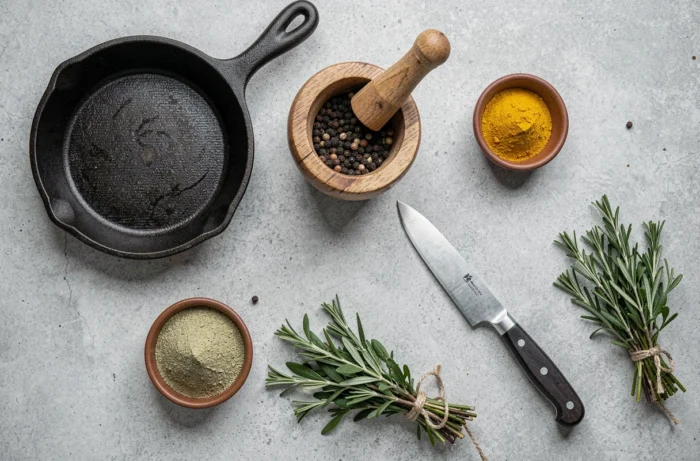
The material of a cooking utensil determines its thermal conductivity, durability, and maintenance. Here is a comparison of common options.
| Material | Thermal Conductivity | Durability | Maintenance | Induction Compatibility |
|---|---|---|---|---|
| Stainless Steel 18/10 | Medium | Very High | Easy | Yes (with magnetic base) |
| Cast Iron | High (slow rise, even diffusion) | Very High | Seasoning required | Yes |
| Aluminum | Very High | Medium | Easy | No (unless with added disc) |
| Copper | Highest | High | Regular polishing | No (unless stainless steel lining) |
| Ceramic (coating) | Variable depending on base | Medium (wear of coating) | Easy | Depends on base |
Cast iron excels for long cooking and stews. Stainless steel is suitable for searing and deglazing due to its reactive surface. Aluminum, lightweight and a good conductor, remains relevant for large frying pans as long as the interior coating is checked against current PFAS standards.
No single material covers all cooking uses. Combining a stainless steel frying pan for searing and a cast iron saucepan for simmering provides more versatility than a complete set in a single material.
Kitchen knife and cutting board: the two purchases that change preparation
Competitors often list about ten utensils. In practice, two items concentrate the clearest comfort gap between a functional kitchen and a frustrating one: the main knife and the board.
A paring knife and a chef’s knife cover almost all daily cuts, from vegetables to herbs. Three quality knives replace a block of ten mediocre blades. The sharpness of the blade matters more than the brand: a hard steel (like carbon steel or high-carbon stainless steel) retains its edge longer, reducing accidents related to a dull blade slipping.
- The paring knife (blade 8 to 10 cm) is used for peeling, trimming, and making small precision cuts on herbs and fresh spices.
- The chef’s knife (blade 20 to 24 cm) covers the majority of cuts: vegetables, meats, herbs in chiffonade.
- The bread knife (serrated blade) remains the only truly useful specialist for hard crusts and tomatoes.
For the board, dense wood (beech, maple) absorbs blade shocks better than plastic and preserves sharpness. A board that is too small forces you to work in multiple passes, which slows down preparation and increases the risk of cuts.
Spice grinders and mortar: choosing the accessory suited to the type of spice
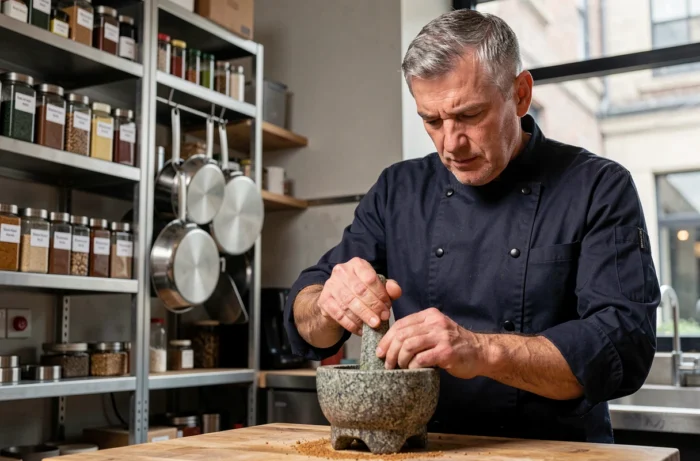
The grinding format changes the result in cooking. A grinder with a ceramic mechanism is suitable for pepper, salt, and hard, dry spices (coriander, whole cumin). Ceramic resists salt corrosion, whereas a steel mechanism may deteriorate.
The mortar and pestle are better suited for fresh or semi-wet spices: garlic, ginger, curry pastes. Crushing releases more important oils than mechanical grinding. A granite or marble mortar offers enough weight to grind without excessive effort.
- Ceramic mechanism: suitable for dry grains, resistant to salt, adjustable grind.
- Steel mechanism: sharper on pepper, but sensitive to oxidation when in contact with moist salt.
- Stone mortar: ideal for spice pastes, aromatic blends, and sauces like pesto.
The choice of grinder depends on the type of spice used, not the design. An unsuitable mechanism produces an uneven grind that disperses poorly during cooking.
Compliance of utensils in contact with food: points to check at purchase
Any utensil intended for food contact must bear the “glass and fork” symbol or an equivalent mention certifying its compliance with European Regulation (EC) No. 1935/2004. This marking covers the main materials, but also inks, adhesives, and coatings.
For products imported from outside the European Union, the manufacturer’s declaration of conformity remains the reference document. The absence of regulatory marking on a new utensil is a warning sign, regardless of the price or reputation of the brand.
Spice accessories (grinders, storage boxes, dispensers) are subject to the same requirements as frying pans and saucepans as long as they touch the food. Checking this point before purchase avoids discovering afterward that a low-quality plastic grinder does not meet the allowed migration thresholds.