
Men’s online fashion suffers from a readability issue. Between capsule collections that disappear in 48 hours, recycled shopping guides from one season to the next, and truncated product sheets, building a coherent wardrobe from a screen requires more method than inspiration. This season’s men’s fashion trends for autumn-winter rely on precise choices of materials and cuts, not on moodboards.
Weight, composition, and finishes: technical criteria before style
An item bought online cannot be touched. The product sheet becomes the only quality filter, and most are incomplete. Three technical data points separate a relevant purchase from a guaranteed return.
The weight of the fabric determines the fit and durability of a piece. A t-shirt with too low a weight will lose its shape after the first wash. For a sweatshirt or hoodie, a sufficiently dense weight ensures a structured drape without premature pilling. When the sheet does not mention this data, it is rarely a good sign.
The composition directly influences seasonal comfort. A wool-cashmere blend will be suitable for autumn but will be stifling under a down jacket in the middle of winter. Recycled polyester dries quickly but retains odors. Before confirming a cart, we recommend cross-referencing the displayed composition with the intended use, not just the aesthetics.
Finally, finishes remain the neglected aspect of online descriptions. Flat seams, contrasting topstitching, corozo or plastic buttons: these details are almost never photographed. Brands that take the time to document them generally indicate a higher quality positioning. To access shopping on Monsieur Simon, this type of transparency regarding finishes is part of the selection criteria for referenced pieces.
Autumn-winter men’s trends: what really changes in cuts
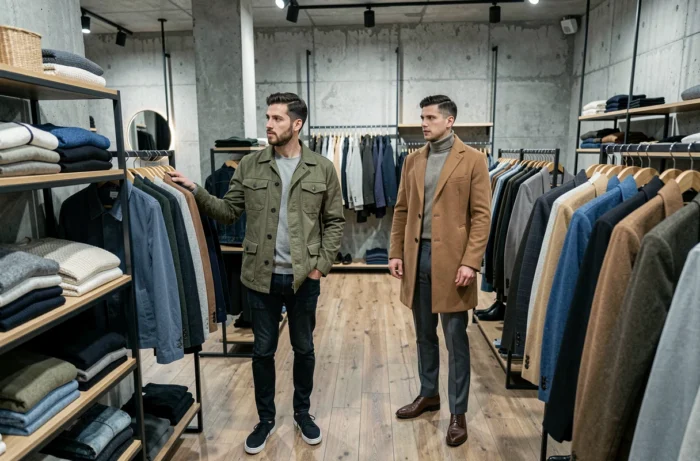
This season, the male silhouette oscillates between two poles. On one side, slim fits return on trousers and some jeans, with a more pronounced taper below the knee. On the other, structured oversized fits persist on the upper body, particularly on coats and padded jackets.
What distinguishes this season from previous ones is the tension between these two volumes worn simultaneously. A fitted pant under a wide overcoat creates a contrast of proportions that brands have been exploiting since the autumn-winter runways. The look works as long as a point of balance is respected: only one voluminous garment per outfit.
Strong materials and seasonal colors
Tweed returns in a lighter version, often mixed with polyamide for added flexibility. Faux fur, driven by the “Mob Wife” trend seen on social media, appears on collars and linings of jackets rather than on full pieces that are difficult to wear daily.
In terms of colors, earthy tones (tobacco, dark khaki, burgundy) dominate. Pink, a legacy of Barbiecore, persists on technical pieces like bombers or lightweight jackets. Accessories absorb bright colors better than main pieces: a colorful beanie or scarf is enough to break the monotony of a neutral winter wardrobe.
Online return policy: what the right of withdrawal covers and does not cover
Buying clothes online involves a structurally high return rate. The fit does not match, the color differs from the screen, the material disappoints to the touch. Knowing the legal framework avoids unpleasant surprises.
The right of withdrawal gives 14 days from receipt to return an item purchased remotely from a professional. This period is a legal minimum, not a commercial favor. Some retailers offer extended return windows (30, 60 days), but these extensions fall under their internal policy and can be changed without notice.
Legal exceptions exist. Clearly personalized items (engraving, custom embroidery, irreversible size adjustments) are not covered by the right of withdrawal. Before ordering a personalized piece, explicitly checking the seller’s return conditions remains the only reliable precaution.
- Always keep the original packaging and tags during the withdrawal period, even if the item is liked upon unpacking.
- Photograph the item upon receipt to document any potential defects, especially on shoes and leather pieces.
- Compare the free return policies between stores: some deduct return shipping costs from the refund, making online trying on significantly less advantageous.

Second-hand online: a purchasing channel to integrate into your wardrobe strategy
Second-hand is growing faster than new in textiles in France, according to a study published by Refashion on September 28, 2026. It is no longer a niche market reserved for vintage: brand boutiques are the fastest-growing segment of second-hand, ahead of peer-to-peer platforms and associative circuits.
For online men’s fashion shopping, this changes the game on two fronts. The first is price: a second-hand branded item costs significantly less than its new equivalent, often in a condition close to new for garments worn only a few times. The second is availability: pieces from past collections, unavailable in stores, reappear on these channels.
Compare channels before buying
Not all second-hand offers are equal. Boutiques operated directly by brands generally offer more rigorous quality control and compliance guarantees. Peer-to-peer platforms offer lower prices but without systematic verification of condition. Finally, associative players practice very accessible prices but with less selective sorting on men’s fashion pieces.
Cross-referencing at least two second-hand channels before a purchase allows you to verify if the requested price corresponds to the actual market condition for a given piece.
An online men’s fashion shopping guide that ignores second-hand in 2026 would be incomplete. The trend no longer concerns only engaged consumers: it is restructuring clothing purchasing habits across the entire market. The most profitable reflex remains to define needs by category of pieces, then systematically compare new and second-hand before each order.