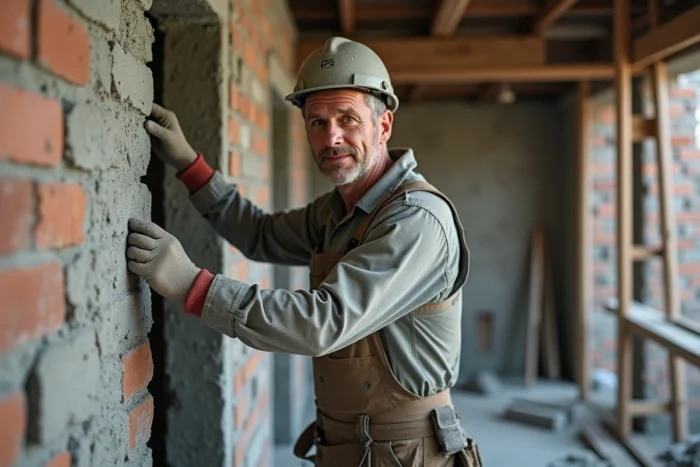
A carefully measured mortar is applied to a brick wall, the proportions of the bag are respected, and three weeks later the joint crumbles under the touch. The reflex is to suspect a poor mix, but the dosage is often just part of the problem. The new mortar that crumbles reveals errors in application or unfavorable site conditions that the dosage alone cannot compensate for.
New mortar that degrades without dosage defects: the role of the substrate and climate
On site, crumbling is regularly observed on perfectly formulated mortars. The problem does not come from the bag, but from what happens before and during application.
An overly dry substrate absorbs the water from the mortar within minutes. The setting accelerates uncontrollably, the cement does not have time to hydrate properly, and the surface becomes crumbly within the first few days. Old bricks, concrete blocks stored in full sunlight, or a masonry wall heated by a south-facing facade cause exactly this phenomenon.
The wind exacerbates the situation. A constant draft over fresh plaster accelerates the evaporation of surface water. The mortar appears to dry, but has not hardened deeply. This results in a fragile crust that detaches in patches or crumbles upon touch.
Heat produces the same effect. Applying mortar to a wall in the middle of summer, without protection, causes a differential shrinkage between the surface and the core of the joint. The outer layer contracts faster, micro-cracks appear, and crumbling follows in the coming weeks. You can find the reasons for crumbling mortar according to La Maison Durable to delve deeper into this early degradation mechanism.
Excess mixing water and insufficient curing: two compounding errors
Excess water is probably the most common technical cause, and yet it continues to be seen on job sites run by professionals. A too-liquid mortar is easier to spread, but this extra water has a direct structural cost.
What excess water concretely changes
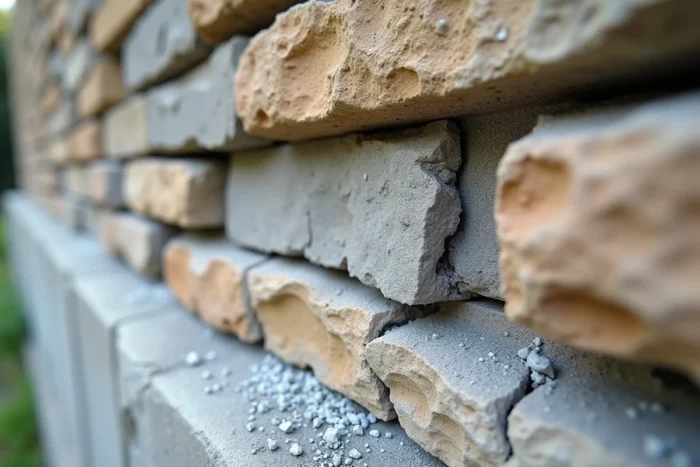
Water that does not participate in the hydration of the cement eventually evaporates. It leaves behind micro-voids in the mortar matrix. These voids reduce mechanical strength and increase shrinkage during drying, which multiplies fine surface cracks.
A mortar mixed with too much water also shows a rise of laitance on the surface, this fine whitish film that easily detaches. On a masonry joint, it gives the impression that the mortar “powders” when you run your finger over it.
Curing the mortar: the step that fast job sites sacrifice
Curing involves keeping the mortar moist during the first days after application. Without curing, the water necessary for the chemical reaction of the cement evaporates before it can do its job. The mortar never reaches its useful strength.
On a facade exposed to the sun or wind, moistening the mortar for at least 48 hours after placement makes a measurable difference in long-term durability. A wet cover, a tarp, or simply regular misting can be used. Feedback varies on the optimal duration depending on the type of mortar, but the principle remains the same: cement needs water to harden, not to dry.
Incompatibility between mortar and substrate: programmed cracks
A mortar that is too rigid applied to a soft substrate concentrates mechanical stresses at the interface. The result is predictable: the joint or plaster cracks and then crumbles, sometimes in just a few weeks.
- A mortar heavily dosed with cement (type M10 or M15) on a wall of soft bricks or limestone creates a rigidity mismatch. The substrate expands and contracts with temperature, the mortar does not follow, and cracking appears at the joints.
- A local repair with a mortar harder than the original joint concentrates stresses on adjacent areas. You repair one spot, and break another.
- On old substrates (cinder, rammed earth, reclaimed bricks), a lime mortar is more compatible than pure cement mortar, as it accommodates the micro-movements of the wall instead of resisting them.
The choice of binder is not just a matter of strength. It is primarily a matter of compatibility with the existing substrate.

Concrete solutions to avoid crumbling and cracks on new mortar
Correcting the issue starts even before opening the bag of mortar. The preparation of the substrate conditions everything else.
- Moisten the substrate before application, without soaking it. The surface should be damp to the touch but without standing water. On highly absorbent bricks, two passes of moistening spaced a few minutes apart yield better results than a single heavy watering.
- Respect the water/binder ratio indicated by the manufacturer, even if the mix seems thick. A firm mortar is harder to work with, but it cracks much less.
- Protect fresh mortar from direct sunlight and wind with a tarp or cover. On exposed facades, delaying application until late in the day reduces the risk of rapid shrinkage.
- Adapt the type of mortar to the substrate: air or hydraulic lime for old masonry, bastard mortar (lime-cement) for mixed substrates, pure cement only on compatible rigid substrates.
If the mortar is already in place and begins to crumble, it is necessary to remove the crumbly part with a scraper until reaching a sound area, moisten, and then redo the joint with an appropriate mortar. Applying a fresh layer of mortar over a crumbling layer does not solve anything; the new mortar will detach along with the old.
A new mortar that crumbles is not a fate linked to product quality. It is almost always a sign of a poorly prepared substrate, absent curing, or a mortar incompatible with its environment. Correcting these three points is usually sufficient to achieve durable joints and coatings.