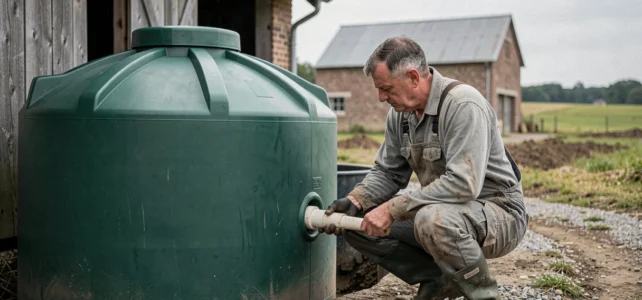
A rainwater tank for agricultural use differs from domestic rainwater collectors in its volume, material, and installation constraints. Prices depend on the type of tank (polyethylene, concrete, flexible tank, IBC), its capacity, and the chosen supply circuit, whether new or used. In 2026, the market shows wide ranges, with significant differences between a modular tank of 1,000 liters and an underground installation of several thousand liters.
Materials and volumes: what determines the price of an agricultural tank
Before comparing prices, it is essential to understand why two tanks of the same capacity can have very different prices. The material is the primary cost factor.
High-density polyethylene (HDPE) dominates the market for medium-capacity agricultural tanks. Resistant to UV rays, lightweight, and compatible with the storage of non-potable water, it is suitable for watering, irrigation, or cleaning equipment. An HDPE tank of 5,000 liters with a collector and tap generally ranges from 600 to 1,200 euros in 2026, depending on irrigation equipment distributors.
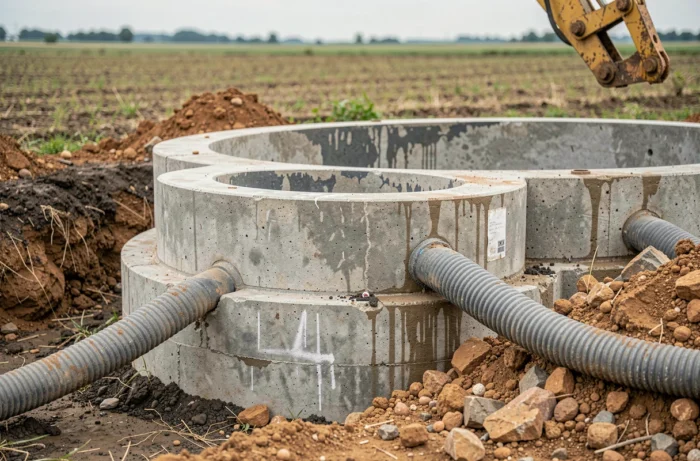
Concrete remains preferred for large-volume underground tanks. Its mass naturally stabilizes the tank in the ground and keeps the water at a low temperature, which limits bacterial growth. The cost is higher, and excavation and lifting equipment installation fees must be added.
Flexible tanks, placed directly on the ground on a sand bed, offer an alternative for farms that want to store large volumes without excavation work. Their price increases proportionally with capacity but remains lower than that of a buried concrete tank for an equivalent volume.
To guide an initial estimate, the prices of tanks on Génération Entreprise detail the ranges by material type and volume.
IBC tanks 1,000 liters: the used market drives prices down
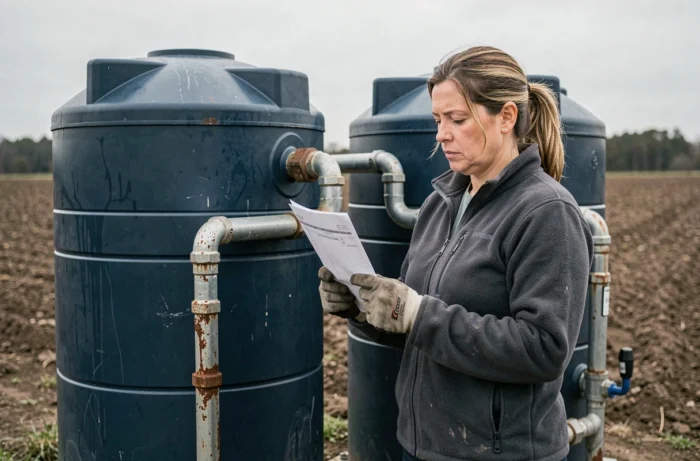
The IBC (Intermediate Bulk Container) tank of 1,000 liters is the most common format on farms that need modular storage. Stackable and movable with a forklift, these tanks allow for multiple collection points without heavy investment.
New, an IBC tank is priced around 150 euros including tax. The difference with the used market is striking: in August 2026, listings show 1,000-liter tanks priced between 40 and 160 euros depending on their condition (new, very good condition, food-grade), with frequent price drops.
This downward pressure from the used market is a factor that traditional pricing guides often overlook. For a farm that needs ten or fifteen tanks spread over different plots, the cost difference between new and used can represent several hundred euros.
A point of caution: used IBC tanks that previously contained chemicals are not suitable for collecting rainwater intended for crop irrigation. Checking the traceability of the previous contents avoids any soil contamination.
Installation cost of an underground agricultural tank
The catalog price of a tank represents only part of the actual budget. For an underground tank, ancillary costs often weigh as much as the tank itself.
- Excavation, which varies according to soil type (clay, rocky, sandy) and burial depth, is the most variable item from one quote to another.
- Connecting to downspouts or collection surfaces (roofs of sheds, livestock buildings) requires pipes, filters, and sometimes a settling tank.
- The lift pump and distribution system to the plots add costs that depend on the distance and elevation difference between the tank and the usage points.
- Backfilling and restoring the site after installation complete the bill.
For a complete installation with a large-volume buried concrete tank, the total cost can easily double compared to the price of the tank alone. Requesting several detailed quotes, item by item, remains the only way to obtain a reliable estimate.
Declaration and regulatory obligations
Any rainwater recovery tank connected to the public sewage system may incur a sewage fee. In strictly agricultural use (irrigation, watering, cleaning equipment), without discharge to the public network, this fee generally does not apply. However, a declaration at the town hall may be required depending on the municipality and the installed volume.
Financial aid for agricultural tanks in 2026
Several local authorities offer subsidies for the purchase of rainwater collectors. These aids vary significantly from one region to another and often target individuals, but some also concern agricultural operations.
The emergency law for the protection and agricultural sovereignty, published in the Official Journal in August 2026, strengthens the support framework for agricultural infrastructure. Regional calls for projects, such as the one renewed in Guadeloupe for supporting agricultural infrastructure, include funding for water storage equipment.
Checking local programs before any purchase can sometimes significantly reduce the investment. The departmental chambers of agriculture and the regional directorates for food, agriculture, and forestry (DRAAF) centralize information on current aids.
The choice between a surface HDPE tank, a battery of used IBCs, or a buried concrete tank primarily depends on the required water volume, site configuration, and available budget, including installation. The 2026 prices show a segmented market, where used options and public aids represent two concrete levers for controlling expenses.