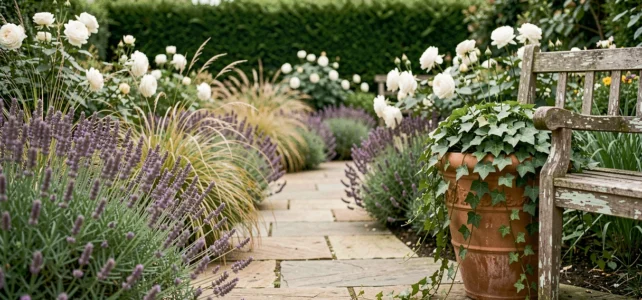
An elegant garden does not rely on the accumulation of plants or furniture, but on the coherence between materials, volumes, and plant layers. Here, we discuss the technical choices that structure a sustainable garden design, in line with recent developments in outdoor design.
Differentiated management of layers: the foundation of a harmonious garden
Differentiated management has become a principle of landscape design in its own right. The concept is based on dividing the garden into several distinct maintenance zones, each with its own mowing or cutting regime.
The area closest to the house is kept closely mowed, with a neat lawn that serves as a visual transition between the built environment and the vegetation. The intermediate zone is mowed higher, accommodating grasses and low perennials. The third layer, at the back of the plot, remains more natural and promotes biodiversity.
This approach creates a remarkable sense of depth. The gradual transition between managed zones and free zones gives the garden a landscape reading that uniform compositions cannot offer. Resources like lejardinierdecorateur.com illustrate this layered composition logic well, applied to both small and large spaces.
Three levels of maintenance in the same garden create visual depth. We recommend marking the transitions between zones with discreet borders made of steel or stone, rather than with blurred mowing lines that lose their clarity within weeks.
Plant palette and plant choices for an elegant garden year-round
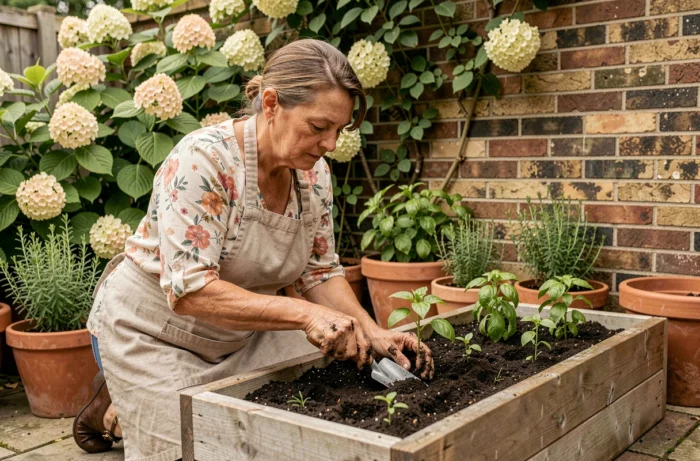
A harmonious garden relies on the persistence of volumes as much as on flowering. Too many compositions focus on annuals or short-flowering perennials, creating a spectacular garden for three months a year and empty the rest of the time.
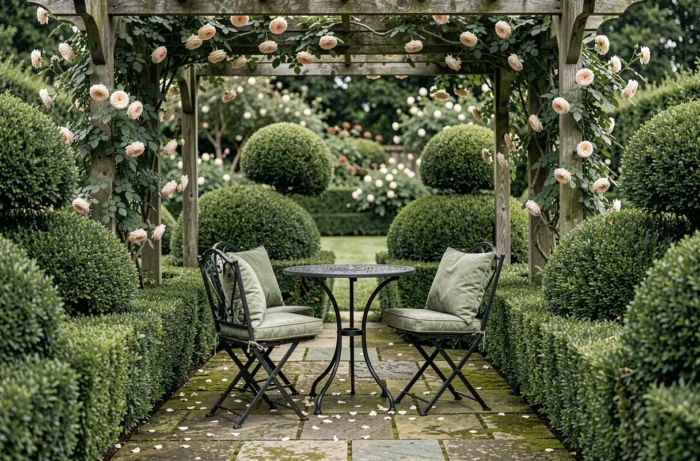
The permanent structure relies on evergreens: boxwood, yews, osmanthus, pittosporum depending on the climate. These plants form the visible skeleton in winter. Among them, ornamental grasses add movement and maintain their shape until late winter.
The dry garden, an elegant response to water restrictions
The dry garden is gaining significant popularity in French requests. Constraints related to drought and water restrictions now shape plant choices from the design stage. It is no longer a niche Mediterranean style, but a pragmatic approach adopted well beyond southern France.
Lavenders, sages, yarrow, and euphorbias tolerate draining soils and very spaced watering. Combined with mineral mulch (limestone gravel, pumice), they create textured beds that require little maintenance while offering extended flowering from spring to autumn.
- Favor plants with deep roots, capable of accessing water deep down during prolonged dry spells
- Group plants by water needs to avoid inconsistent watering in the same area
- Always mulch beds with a mineral or organic layer thick enough to limit evaporation
Materials and outdoor style: trends shaping garden design
The trend for 2025-2026 is moving away from very mineral and uniform exteriors. Uniform light gray composite terraces or immaculate white gravel are giving way to more authentic materials: natural stone, solid wood, and corten steel.
Color palettes are evolving as well. Ochre, terracotta, and olive green are replacing the cold grays and whites that have dominated the last decade. This shift towards warm tones harmonizes better with plants and creates a more natural visual coherence between the ground, structures, and plantings.
Material reminders between interior and exterior
The elegance of an outdoor layout often lies in its continuity with the architecture of the house. A stone paving that extends the indoor tiling, a wooden pergola whose wood species echoes the facade’s joinery: these reminders create a fluid reading between inside and outside.
Limiting the palette to two or three materials avoids visual fragmentation. A garden that mixes composite, woven resin, stainless steel, polished concrete, and treated wood loses all coherence, regardless of the care given to the plantings.
Structuring the garden space with voids and solids
We often observe a filling reflex among individuals: every square meter must receive a bed, a pot, or an accessory. The result is a saturated space that does not allow the eye to breathe.
An elegant garden relies on the alternation between densely planted areas and open spaces. An empty lawn framed by tall beds creates a stage effect. A clear path between two hedges guides the eye and produces perspective.
- Empty zones (lawn, paving, gravel) serve as visual rest and highlight adjacent beds
- Grouped plant masses in coherent blocks have more impact than a scattering of isolated plants
- Focal points (remarkable tree, fountain, sculpture) only work if they are surrounded by emptiness
A garden is composed like a painting, with foregrounds and backgrounds. Tall trees at the back of the plot, shrubs in the middle ground, and low perennials at the edge reproduce this logic of successive planes that gives depth, even on a modest surface.
The temptation to fill every corner with a pot or planter produces the opposite effect of what is sought. It is better to have a generously composed bed than ten pots scattered without logic. The choice to leave empty spaces is a design act, not a lack of ideas.