
Your phone suggests the end of your sentences, your watch monitors your heart rate, and your smart speaker adjusts the heating. These tech trends are no longer distant promises. They’re already in our pockets, homes, and offices, transforming our daily lives at a pace that raises practical questions—especially about their true cost.
The energy cost of digital habits: who pays the bill for our tech use?
Have you ever noticed how your voice assistant responds in a fraction of a second? That speed depends on data centers that consume massive amounts of electricity. The International Energy Agency (IEA) has warned that the growth of these facilities is creating challenges for connecting them to the power grid.
The problem goes beyond raw consumption. The IEA stresses the need to better anticipate demand, improve energy efficiency, and share infrastructure costs fairly between digital companies and the communities that host them. Without clear rules, local authorities and consumers end up shouldering the burden.
In practical terms, each request to an artificial intelligence model uses more resources than a standard search. Multiply that by millions of daily users, and energy costs become as much a political issue as a technological one. The analysis available in Yann Savidan’s tech section tracks these issues as they evolve.
AI at work: real-world adoption and practical limitations
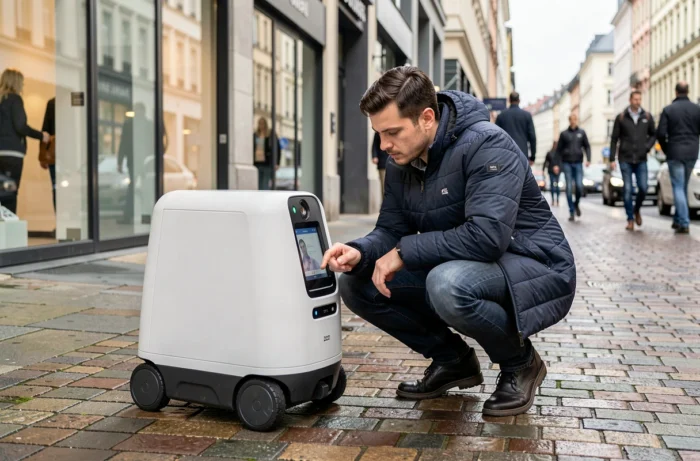
AI is about more than chatbots that generate text. In businesses, it now affects operational processes, including automated résumé screening, bank fraud detection, and medical diagnostic support. Adoption is growing, but remains highly uneven.
Large companies are adopting AI much faster than small businesses. Eurostat statistics on EU businesses show a marked gap between larger organizations, which are often equipped to use AI, and SMEs, where its use remains experimental or occasional. Most applications are concentrated in the information and communications and professional services sectors.
This reality challenges the idea of a uniform transformation. A five-person architecture firm doesn’t use AI in the same way as an international bank. For many small businesses, AI is still limited to a writing or translation tool, far from the full automation promised by marketing claims.
What’s changing nonetheless
AI is subtly changing how work is organized. Summary meetings are sometimes replaced by automatically generated minutes. Sales teams use scoring tools to prioritize leads. Less eye-catching than a humanoid robot, these are the applications that are genuinely transforming everyday working life.
European AI regulation: requirements coming into force
The European AI Act is no longer just a proposal. Transparency rules apply from August 2, 2026. They require certain interactions with AI, as well as certain content generated or modified by an automated system, to be disclosed.
One requirement has already been in force since February 2, 2025: organizations must ensure that people who use AI have the necessary AI literacy. In other words, employee training is no longer optional—it’s a regulatory requirement.
Why does this timeline matter in everyday life? Because it will change how the apps we use every day must work. A photo filter that alters a face, a customer service chatbot, or a content recommendation tool: all will have to clearly identify their artificial nature once the transparency rules take effect.
- Disclosure of interactions with AI required in certain contexts, effective August 2, 2026
- AI literacy training for professional users, mandatory since February 2, 2025
- Labeling of content generated or modified by AI, so the public can distinguish synthetic content from real content

Repairability of electronic devices: new product rules on the horizon
Technological innovation also creates waste. The European Commission is preparing new repairability rules for electronics, small appliances, and electric bikes. For now, this is a planned initiative, not a set of finalized requirements.
The principle goes beyond recycling. Repairing rather than replacing means rethinking product design from the outset: access to spare parts, publicly available technical documentation, and how long components remain available.
A direct link to everyday use
Your smartphone with a non-replaceable battery, wireless earbuds that can’t be taken apart, or robot vacuum with a motor glued to its chassis: these design choices come at a cost to users and the environment. The upcoming European rules are specifically aimed at situations like these.
Repairability is becoming a product policy criterion, alongside performance and design. If these rules are adopted, they could change manufacturers’ product ranges even before they are transposed into national law.
Digital innovation and responsibility: what’s at stake now
The tech trends transforming our daily lives are about more than a list of gadgets. They raise fundamental questions about how costs are shared, how users are trained, and how sustainable products are.
- Data center energy infrastructure puts pressure on local power grids, while rules for sharing the costs have yet to be settled
- AI adoption in business remains concentrated in large organizations and certain sectors, far from a widespread transformation
- European regulations now impose concrete transparency and training requirements, with deadlines approaching
- Repairability of electronic devices could become a design requirement, not just a selling point
The real challenge in the coming years isn’t figuring out which technologies will exist. It’s deciding who will bear their material and regulatory consequences. The answers will shape our relationship with innovation far more than any new feature.