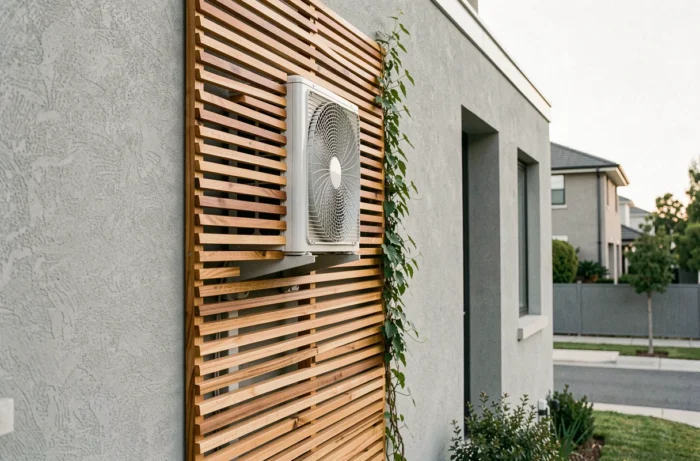
An outdoor air conditioning unit vibrates, blows out hot air and produces condensate. Concealing it on a façade means balancing aesthetics, thermodynamics and access for maintenance. The ideal cover makes the unit invisible without blocking airflow or making servicing more difficult.
Removable air conditioner cover: design an enclosure that remains accessible
Most home décor guides feature fixed enclosures screwed or glued to the façade. The problem arises when a technician needs to access the compressor, check the refrigerant circuit or replace a fan. A non-removable cover has to be destroyed and then rebuilt, damaging the façade and increasing the bill.
A removable cover is built around a frame independent of the wall. The idea is to secure a load-bearing frame to the ground or to wall plates, then fit the decorative panels using clips, hinges or sliding rails. The technician can remove a panel in seconds, carry out the work and put it back in place.
Three points deserve particular attention during the design process:
- Condensate drainage: the cover must include a low-level opening for the drain hose or a channel leading to a discreet outlet. Otherwise, water will pool and could lead to a dispute with neighbours.
- The unit’s wall fixings: the cover frame must never share the same wall plugs as the air conditioner bracket, or vibrations could be transmitted to the façade and weaken the anchors.
- Rear clearance: there must be open space between the unit and the wall to allow air to circulate. A solid rear panel turns the cover into an oven and reduces the unit’s efficiency.
To find out how to conceal an air conditioner while preserving access, the basic rule is never to sacrifice removability for appearance.
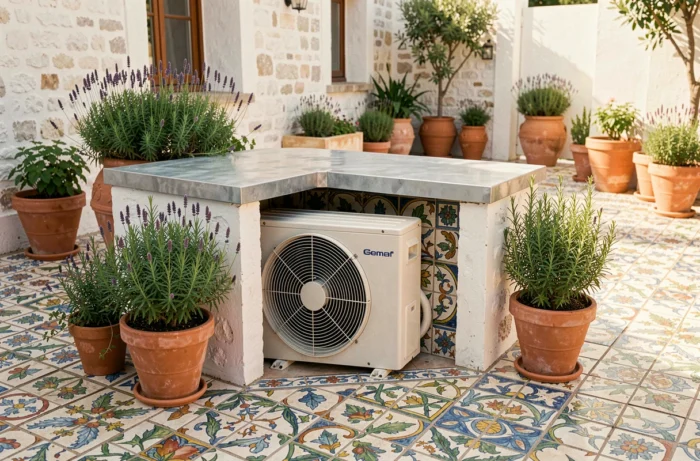
Airflow and performance: clearances to maintain around the outdoor unit
An outdoor air conditioner draws in ambient air and expels hot air. If the cover leaves too little space around the unit, it will draw in its own hot exhaust air, increasing energy consumption and shortening the compressor’s lifespan.
Manufacturers specify minimum clearances between the unit and any obstacle. Daikin and Mitsubishi Electric manuals generally call for sufficient clearance in front of the unit for air discharge, as well as space at the sides and above for air intake. Since dimensions vary by model, checking the manual before sizing the cover is essential.
Requirements differ in areas exposed to sea winds or the mistral. Daikin, for example, recommends protecting the unit from direct sea winds, while Mitsubishi Electric advises against saline environments for certain models. In these conditions, a louvred cover facing the prevailing winds can serve two purposes: protection and an attractive finish.
Openwork panels or louvres: what opening ratio should you aim for?
A solid panel blocks all airflow. An angled louvre panel lets air through while concealing the unit from view. The panel’s open area directly affects the air conditioner’s performance. Aluminium covers with adjustable slats make it possible to change the opening ratio according to the season, an advantage over fixed wooden latticework.
In practical terms, a panel with more than half its surface open—whether it uses louvres, slats or a grille—has virtually no effect on airflow. Below this threshold, the drop in efficiency becomes measurable.
Planning permission and co-ownership: what to do before installing an air conditioner cover on the façade
Adding a cover changes the appearance of a façade. In France, any alteration to a building’s exterior appearance may require a prior works declaration submitted to the local planning department. This applies to the enclosure itself, not just the air conditioner it conceals. A cover made from exotic wood installed on a dressed-stone wall in a protected area may be rejected by an architect from the French heritage authority.
In a co-owned building, there are two requirements to meet. Approval from the local council and approval from the general meeting of co-owners are separate and cumulative requirements. Installing a cover on a shared area, such as a façade or balcony, without a vote at the general meeting may result in an order to restore it to its original condition. Article 25 b of the law of 10 July 1965 governs these approvals.
Co-ownership rules and a consistent façade
Some co-ownership rules require all equipment visible from the street to be the same colour. Checking the building’s design guidelines before ordering a natural wood or anthracite aluminium cover can help avoid a costly dispute with the property manager.
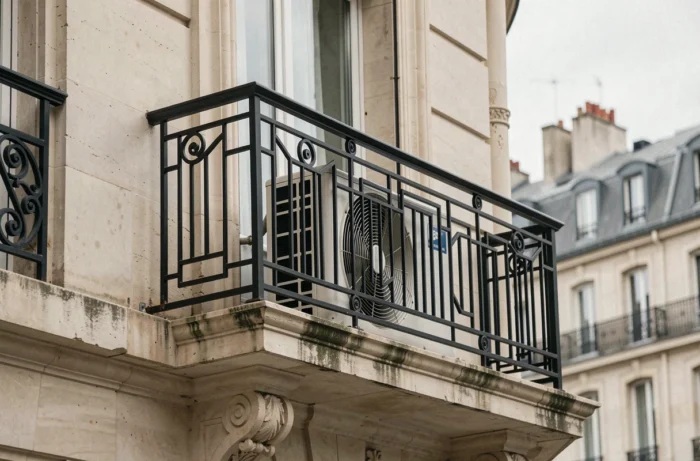
Choosing an air conditioner cover material to suit your façade
The cover material is about more than appearance. It determines durability, the load placed on the façade and the maintenance required.
- Powder-coated aluminium resists UV rays, does not rust and is available in RAL colours to match your window frames. Its low weight makes it suitable for lightweight façades and balconies.
- Wood (treated pine, larch or composite wood) works well with timber-clad homes and façades finished in stone-effect render. It needs regular treatment to protect it from moisture, especially if condensate drains nearby.
- A planted trellis (a metal support with climbing plants) creates a natural look but requires upkeep: trim it regularly to prevent foliage from blocking the unit’s ventilation grilles.
Whatever the material, the cover must be removable without specialist tools. A clip or hinge system lets the technician open the front panel in under a minute, which is essential for any warranty work.
The final choice depends as much on local planning rules as on the architectural style. A horizontal-louvre aluminium cover blends into a contemporary façade, while a slatted wooden enclosure is better suited to traditional render. Matching the cover to existing shutters, railings or gates is the most reliable way to preserve the façade’s character.