
Starting a carpentry training program when you have children, rent to pay, and family schedules to respect is a project that requires more than just signing up. Adult carpentry training involves reorganizing your daily life over several months, sometimes a full year. The targeted diploma (often a CAP in carpentry manufacturing) opens real doors in the construction industry, but the journey requires preparation that goes far beyond just choosing the training organization.
Out-of-pocket expenses for CPF and family budget: what has changed recently
Before discussing schedules, let’s talk money. Since May 2024, a decree (n°2024-376) has established a mandatory out-of-pocket expense of 100 euros for most training programs funded through the Personal Training Account. Carpentry training is no exception.
Since April 2, 2026, an additional contribution of 150 euros also applies, in accordance with decree n°2026-234. Certain groups are exempt: RSA beneficiaries, disabled workers, job seekers in specific cases.
For a family with a single income during the career transition, these amounts add to transportation costs, personal tools, and sometimes childcare. Several organizations offer adult courses on ecoledestravaux.fr that detail funding options tailored to family profiles. The key point to remember: the CPF no longer covers the entire cost, and you need to anticipate this expense right from the application process.

Alternating carpentry training or evening classes: what format for a parent
Have you ever tried to fit a day of classes between school pick-up and dinner preparation? The format of the training directly affects the feasibility of the family project.
One-year apprenticeship
The CAP in carpentry manufacturing through an apprenticeship generally lasts one year for adults in retraining. The Compagnons du Devoir, for example, offer this format in Marseille and other cities. The apprenticeship involves weeks in a company and weeks in a training center.
The apprenticeship generates income during training, which alleviates financial pressure. In return, the hours are those of a full-time job. A single parent will need a reliable childcare solution for the entire duration.
Evening classes and modular training
Some organizations offer evening classes or weekend sessions. This format is better suited for someone who retains a job alongside. The total duration extends, sometimes up to two years for a complete CAP.
The compromise is clear: less disruption to the family routine on a daily basis, but accumulated fatigue over a longer period. Consistency matters more than intensity in this type of journey.
Distance learning (theoretical component)
The theoretical part of the CAP in carpentry can be prepared remotely, as a free candidate. The practical part, however, requires an equipped workshop and supervision. This hybrid format allows for studying theory in the evening after the children are asleep, then grouping practical sessions during defined periods.
Organizing family time during a carpentry retraining
The real issue, beyond the choice of training, is domestic logistics. A retraining requires between twenty and forty hours per week depending on the chosen format. Here are the concrete points to consider before starting:
- Childcare during atypical hours (workshops on Saturdays, classes at the end of the day). Check the exact slots of the training center before enrollment, not after.
- Distribution of household tasks with your partner or family. An explicit agreement in advance avoids tensions after three months of fatigue.
- Maintaining a minimum personal time. An exhausted parent gives up more quickly than a supported parent. Blocking off half a day per week without classes or family obligations is not a luxury.
- The budget for food and transportation, which mechanically increases with travel to the training center or host company.
Why emphasize these practical details? Because the majority of dropouts in adult training do not stem from a lack of skills. They arise from a living environment that has not been adapted to the new rhythm.
Carpentry skills and job opportunities in construction
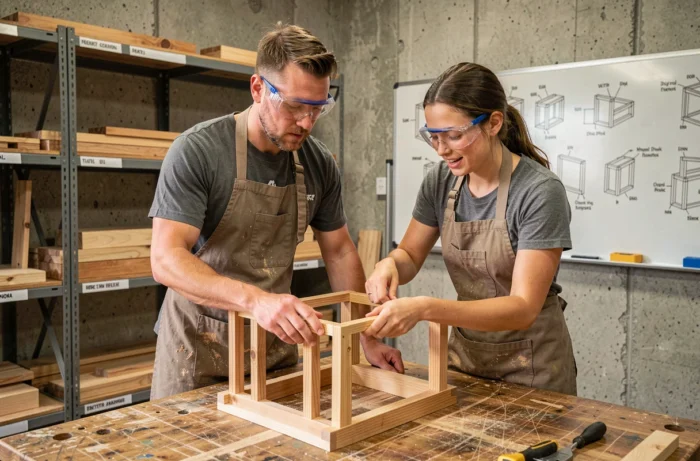
The CAP in carpentry manufacturing trains for workshop work: manufacturing windows, doors, interior fittings, and furniture. The CAP in carpentry installation, on the other hand, directs towards the construction site. Both diplomas are at level 3 and recognized by the State.
The construction sector is hiring qualified carpenters, particularly in small and medium-sized enterprises. An adult retraining profile, with previous professional experience, often brings valuable transferable skills: project management, rigor, autonomy.
After the CAP, several paths exist:
- Employment as a carpenter in interior design or construction, with gradual skill development.
- Further training towards a professional baccalaureate or a BTS in interior design to access supervisory positions.
- Establishing oneself as a craftsman, which requires a professional title or recognized diploma, plus registration in the trades directory.
The diploma alone is not enough: internships during training build the network that leads to the first job. A good internship supervisor can become the first employer.
Funding carpentry training: the schemes to combine
The CPF remains the main funding scheme, despite the out-of-pocket expense. For job seekers, France Travail can supplement funding through the AIF (Individual Training Aid). Employees can apply for a professional transition project (formerly CIF), which maintains part of the salary during training.
Combining CPF, OPCO, and regional aids often allows for covering almost all expenses. The administrative setup takes time, sometimes several months. Start the process at least six months before the targeted start date.
A final often overlooked point: check that your current employer (if you are employed) does not require a formal agreement before mobilizing the CPF during work hours. Due to recent changes, some training programs require a request letter within specific timeframes.
Carpentry is a profession built with hands and time. A well-calibrated training path, properly funded and integrated into a realistic family rhythm, has every chance of success. The first concrete step remains to contact the targeted training center to obtain the exact course schedule, then to place this schedule alongside the family’s.