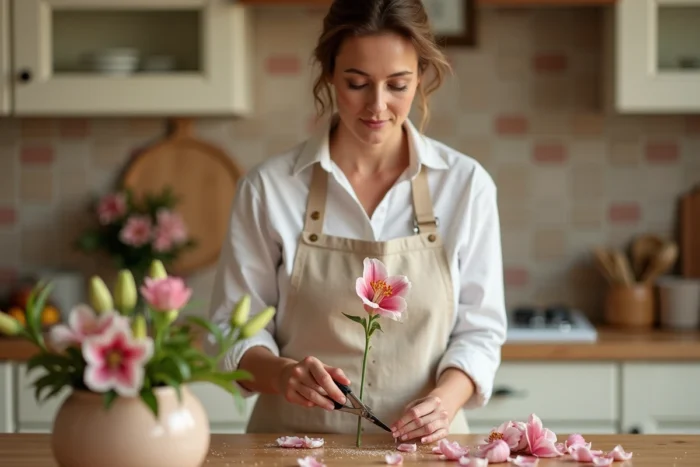
The pistil of the lily does not pose any physiological problem to the flower. It is the stamens and their pollen-laden anthers that require prompt intervention, well before the bud is fully open. We are talking about a precise action, often poorly described in popular guides, which confuse the pistil (female organ, unique, central) and stamens (male organs, peripheral, carrying the pollen). This distinction conditions everything else.
Floral anatomy of the lily: pistil, stamens, and anthers
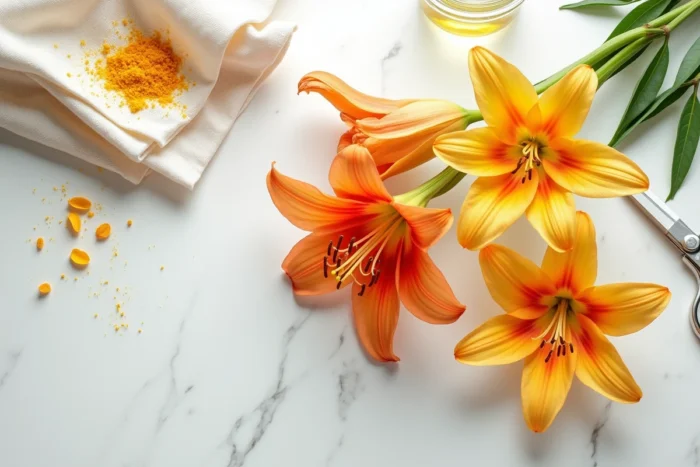
A lily has six stamens arranged in a crown around a central pistil. Each stamen ends with an oblong anther, covered with highly pigmented orange or brown pollen. The pistil, on the other hand, is topped with a sticky trifid stigma, designed to capture this pollen for fertilization.
When we talk about “cutting the pistil of lilies,” we are actually referring to the removal of the anthers. Removing the pistil has no practical interest: it does not produce pollen, does not stain fingers or textiles, and its removal deprives the flower of its central axis without benefit.
We recommend targeting only the anthers. A detailed guide explains how to cut the pistil of lilies by distinguishing the organs to be removed according to the desired objective. The stakes boil down to two things: avoiding pollen stains and prolonging the flower’s lifespan.
Removing the anthers from the lily: timing and technique
The optimal moment is just after the bud opens, when the anthers are still closed and slightly moist. At this stage, the pollen is not yet powdery. It remains compact, stuck to the anther, and does not disperse at the slightest contact.
Intervention window
On an oriental lily in a vase, the petals gradually spread over half a day. The anthers become powdery within a few hours depending on the ambient temperature. In a heated indoor environment, this window is significantly reduced.
If the anthers have already released pollen, the operation is still possible but the risk of staining the petals and surrounding surfaces increases. Wear thin nitrile gloves instead of latex, which sticks more to the pollen grains.
Technical gesture
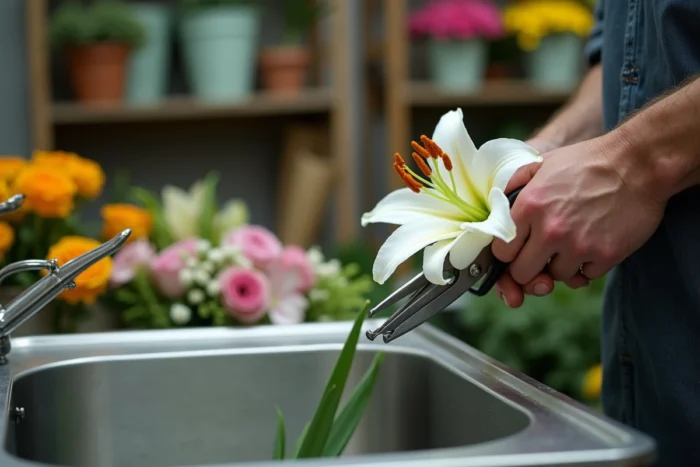
- Hold each anther between the thumb and index finger, at the base, where it joins the filament of the stamen, and gently pull outward from the flower to remove it without shaking
- Do not use scissors: cutting releases pollen through vibration and leaves a quickly browning filament stub, which detracts from aesthetics
- Work over absorbent paper or a bag, never over light fabric or a tablecloth
- Proceed flower by flower as the buds open, not all at once on the entire stem
Clean manual removal prevents browning of the filament and provides a cleaner result than cutting with scissors. We observe that this difference is visible several days after the intervention.
Lily pollen: stains and risks indoors
Lilium pollen is one of the most stubborn on textile fibers. Its pigmentation comes from soluble carotenoids that penetrate natural fibers (cotton, linen, silk) within minutes. A dry rub sets the stain instead of removing it.
The correct technique is to apply a piece of adhesive tape to the fresh stain to lift the grains without crushing them. Water, especially warm water, worsens the penetration of the pigment. A machine wash without pretreatment makes the stain almost permanent on white cotton.
Health and comfort dimension
Care guides focus on the aesthetics and longevity of the bouquet, but lily pollen also presents an irritant potential for the respiratory tract. In a poorly ventilated space, the dispersion of dry pollen can cause sneezing and eye discomfort in sensitive individuals.
For households with young children or pets, removing the anthers as soon as they open reduces exposure to pollen indoors. This preventive action transforms the lily, often excluded from indoor arrangements for this reason, into a flower compatible with a living room or bedroom.
Effect on the lifespan of the lily in a vase
Removing the anthers prevents the pollination of the stigma. Without fertilization, the flower does not trigger the seed formation process, which mobilizes a significant portion of the reserves from the stem and bulb. The flower remains in the active blooming phase longer.
On an Asian lily in a vase, we observe that the early removal of the anthers extends the lifespan by several days compared to an unaltered flower. The effect is more pronounced when the stem still bears closed buds: the energy not diverted towards fruiting benefits the subsequent buds.
Combination with vase maintenance
- Recut the stem at an angle every two days to maintain water absorption
- Change the water daily, without sweet preservative that promotes bacteria in stagnant water
- Keep the vase away from fruits (ethylene accelerates petal senescence)
These actions combined with the removal of the anthers constitute the complete protocol to maximize the bouquet’s lifespan. Removing the anthers without maintaining the vase water yields only partial benefits.
Lilies in the ground: should you intervene on the stamens in the garden?
Outdoors, the question arises differently. Removing the anthers prevents seed production and stops the plant from wasting its reserves. The bulb thus more effectively replenishes its resources for the next blooming.
However, if you are growing botanical lilies and want to multiply them by seed, the anthers must remain in place to ensure pollination, whether natural or assisted. The choice depends on the goal: abundant blooming the following year or seed production.
For potted oriental lilies, often more fragile than their garden counterparts, removing the anthers combined with keeping the foliage intact after blooming offers the best chances for re-blooming. The foliage continues to photosynthesize and nourish the bulb as long as it remains green.
The important gesture, both in the garden and in a vase, remains the same: intervene early, handle the anthers without dispersing the pollen, and leave the central pistil in place. The latter does not interfere at all, and its removal weakens the flower’s structure without providing measurable benefit.