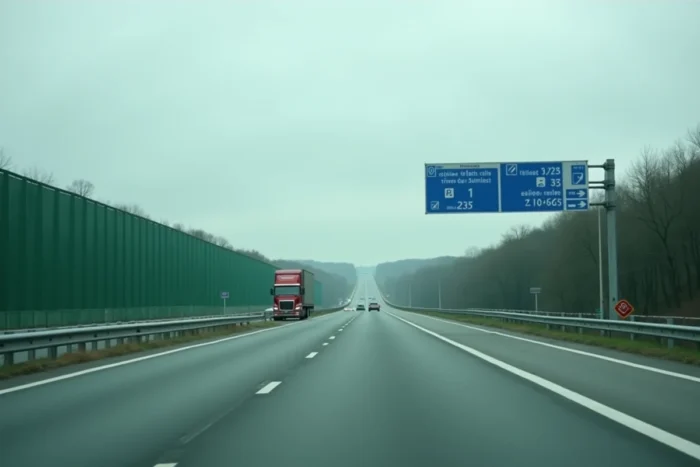
The French motorway network has about a quarter of its kilometers without tolls. These sections, managed directly by the State or local authorities, do not charge users upon passage. In 2026, several mechanisms will redefine what “free” really means on a motorway, including the deployment of free-flow tolling, requalification of existing routes, and contested projects that alter traffic patterns.
Free-flow tolling and the free motorway network: a blurred boundary
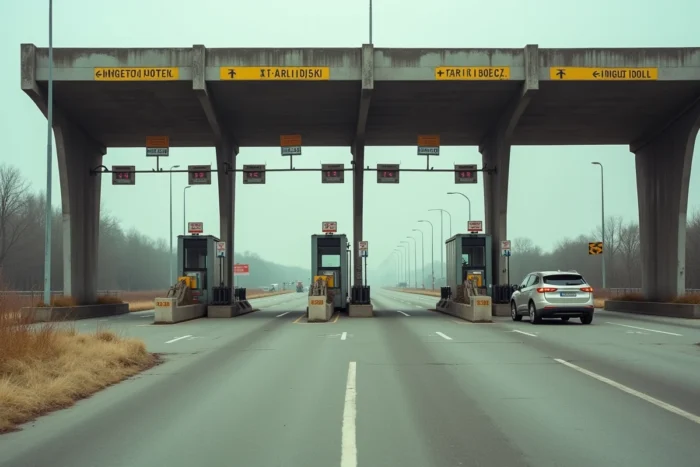
The free-flow tolling eliminates physical barriers. Vehicles pass without slowing down, detected by gantries equipped with cameras and sensors. The toll is collected afterward, via a toll badge or license plate billing.
This system, already operational on the A79 and sections A13/A14, is gradually being rolled out. The A40 and A69 are announced or in the process of transitioning to this model. For motorists, the driving experience resembles that of a free motorway: no stops, no waiting lines. Billing arrives later, sometimes with delays that surprise occasional users.
This confusion has concrete consequences. A driver using a free-flow section without a badge or prior arrangement is subject to penalties. The absence of a barrier does not mean the absence of a toll, and the distinction between free routes and free-flow routes becomes a trap for those who do not inform themselves before departing. To follow motorway projects on Pulsion Laval, the mapping of the affected sections remains a useful reference.
Funding for free motorways in 2026: where the concession money goes
A toll-free motorway is not a cost-free motorway. The maintenance of the non-conceded network (roads, signage, structures) relies on the State budget and interdepartmental road management. The funding question takes on a political turn in 2026.
The government has announced a plan to reallocate motorway revenues. A portion of the income from concessions is to be directed towards the railway network and the maintenance of existing road infrastructures. This transfer, intended to compensate for chronic underinvestment in the non-conceded network, is progressing more slowly than expected.
The mechanism is as follows: concession companies pay a tax on their profits, and this revenue feeds into a fund dedicated to transportation. In practice, the implementation schedule is slipping, and the SNCF is covering part of the funding in the meantime. This delay directly impacts the State’s ability to maintain and modernize free sections.
- Revenues from motorway concessions are partially redirected towards railways and maintenance of the non-conceded network
- The free network depends on the public budget, which is structurally more constrained than toll revenues
- The requalification of existing routes (like the ongoing program on the A7 near Valence) mobilizes mixed funding between the State and concessionaires
Toll sticker: a scenario resurfacing
The debate over a toll sticker periodically resurfaces. In 2026, the question arises more acutely at the French-Spanish border, where discussions about shifting from a free model to a sticker or toll system have been reignited. Such a shift, if realized on other routes, would change the very definition of the French free network.
A69 Toulouse-Castres: a motorway project reshaping traffic flows
The A69 between Toulouse and Castres concentrates tensions between network development and environmental opposition. The Council of State validated the environmental permits for this project on June 29, 2026, while the construction was already well advanced. The announced toll is around 16 euros for a one-way trip.
This rate pushes some users to seek alternative routes on the existing free network. The national and departmental roads already connecting Toulouse to Castres are likely to see their traffic evolve asymmetrically: heavy trucks on the toll motorway, individuals on the free roads.
This phenomenon of traffic diversion illustrates a recurring paradox. Each new toll motorway alters the usage of the surrounding free network, sometimes overloading it, sometimes relieving it. The impact depends on the toll rate, distance, and quality of alternatives.
Requalification of the existing network: modernizing without building new lanes
Not all motorway projects in 2026 involve the construction of new sections. The requalification of existing motorways is a discreet but structuring area of work. Vinci Autoroutes has inaugurated the first requalification improvements on the A7 near Valence, a program aimed at enhancing safety and fluidity without massive widening.
In Île-de-France, interdepartmental road management conducts regular work on the non-conceded network. These interventions focus on road resurfacing, upgrading interchanges, and managing chronic congestion.
- The requalification targets safety (guardrails, signage) and fluidity (entry lanes, interchanges) on already operational routes
- In Seine-et-Marne, a “green road” experiment tests new surfaces and equipment on the departmental network
- These projects mobilize public budgets and do not lead to new tolls for users
This approach responds to a simple constraint: projects to create new motorways face increasingly structured environmental opposition, lengthy legal procedures, and rising land acquisition costs. Modernizing the existing network is cheaper and encounters less resistance.
Regulatory obligations 2026: what changes for heavy goods vehicles
A regulatory evolution in 2026 specifically affects utility vehicles and heavy trucks operating on the motorway network. The extension of the obligation for the second-generation smart tachograph modifies the circulation conditions for transporters. This device records position, speed, and driving times with increased accuracy.
For managers of the free network, this obligation facilitates the control of heavy traffic on routes where regulation previously relied on more limited means. Transporters must factor in the cost of bringing their fleets into compliance, which weighs on the sector’s margins.
The French free motorway network remains accessible without passage fees in 2026. However, its sustainability depends on budgetary decisions made far from the access ramps, amid political trade-offs on concession revenues and the State’s ability to finance the maintenance of an aging road heritage.