The choice of a headpiece for a wedding ceremony remains one of the most codified dressing exercises. Traditions vary according to regions, families, and the degree of formality of the event. Recent trends, particularly the rise of sorbet palettes and natural materials, add a layer of complexity for any guest wishing to wear a hat without making a faux pas.
Color palette 2026 and ceremonial hat: what the trend changes
Competitors extensively discuss hat shapes (bibi, wide-brimmed, fascinator), but the question of color is often overlooked. The wedding guest dress trends for 2026 lean towards sorbet shades like powder pink, butter yellow, or glacier blue. This chromatic shift has a direct impact on the choice of hat.
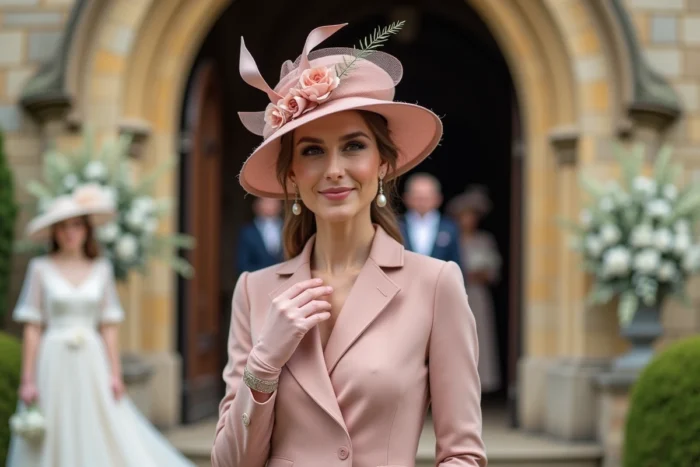
A sorbet-colored hat close to the dress creates a discreet tone-on-tone effect, perceived as sophisticated without overwhelming the silhouette. Soft neutrals (ivory, champagne, rosy nude) remain a safe bet to avoid any visual conflict with a very colorful dress. On the other hand, a hat in a bold color opposite to the dress disrupts the overall balance and draws attention to the wrong place.
Wearing a wedding hat for guests therefore involves thinking of the outfit as a coherent color block, from the headpiece to the shoes, rather than treating the hat as a standalone accessory.
Hat, manicure, and accessory coordination: an underestimated rule of elegance
Most guides limit themselves to the dress-hat duo. Current recommendations from fashion experts go further: the manicure, jewelry, and bag contribute to the overall balance of the ceremonial outfit.
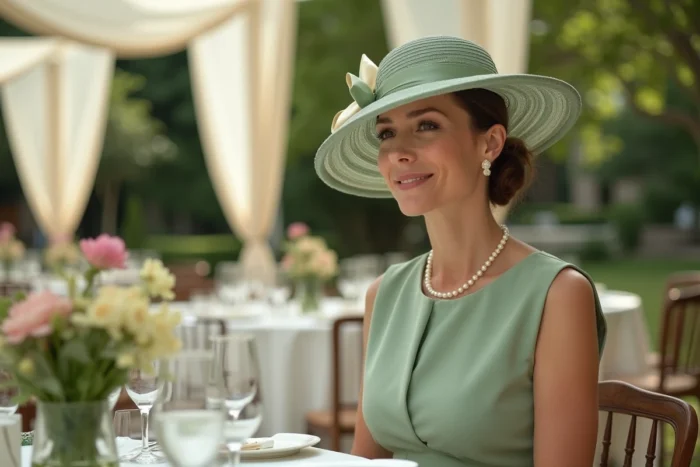
A highly detailed hat (bibi adorned with feathers, fascinator with veil) gains elegance when paired with a subtle and luminous manicure like baby boomer or milky nails. The idea is to avoid having two elements of the outfit competing for attention. Conversely, a pastel outfit with a straw hat can be modernized with cat-eye nail art in champagne or rosy nude tones, which captures light without overwhelming.
This coordination logic also applies to jewelry. An imposing hat calls for discreet earrings. A minimalist bibi allows for a more assertive necklace. The principle remains the same: one focal point per outfit, not three.
Hat shape and ceremony context: the real selection criteria
The location and time of the ceremony dictate the shape of the hat much more than the guest’s personal preferences. Here are the criteria that truly matter:
- For an outdoor summer wedding, a wide-brimmed hat or structured straw Panama protects from the sun while remaining elegant, provided the brims do not obstruct the view of neighboring guests during the ceremony.
- For an indoor ceremony or late in the day, a bibi or fascinator is essential: their small size does not block the view, and their lightness allows them to be worn all evening without discomfort.
- For a rustic or bohemian wedding, a simple boater or a cloche hat made of natural material blends into the setting without appearing too formal.
- For a high-end reception (castle, palace), a large hat with wide brims remains the most suitable choice, provided it does not exceed the size of the mother of the bride’s hat.
The question of hierarchy among guests is not trivial. In some families, a friend wearing an imposing hat while the mother of the bride does not may be perceived as a lack of tact. Field feedback varies on this point according to regions and family traditions, but the principle of caution remains in place.
Common mistakes in choosing a wedding hat
Some mistakes consistently arise and turn an elegant accessory into a source of embarrassment for both the guest and other attendees.
The white or ivory hat when not the bride
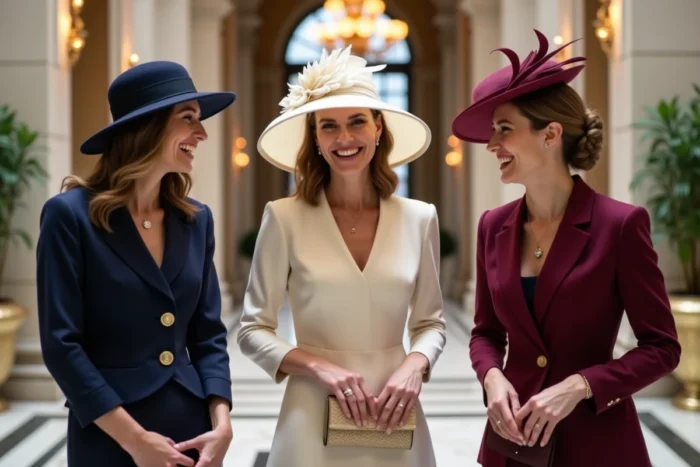
Even if the shade differs from the bride’s dress, a white or ivory hat on a guest creates visual confusion, especially in group photos. White is reserved for the bride, hat included.
The hat too wide for the religious ceremony
A wide-brimmed hat that extends well beyond the shoulders blocks the view of those sitting behind. In a religious ceremony, where the rows are tight, this discomfort quickly becomes a point of tension. The fascinator or bibi avoids this problem.
The hat removed during the meal
According to traditional etiquette, a woman can keep her hat on at the table during a formal event. However, a large hat placed on the table or wedged on an empty chair becomes a logistical obstacle. Choosing a model that can be worn all day without discomfort remains the best strategy.
Natural materials and eco-friendly trend in ceremonial millinery
Natural materials (braided straw, sisal, raffia) have dominated wedding millinery collections for several seasons. This trend corresponds to a dual movement: the growing demand for eco-friendly accessories and the preference for lightweight textures suitable for outdoor summer weddings.
French artisanal millinery remains active with a network of workshops specializing in custom-made pieces. An artisanal hat allows for precise adjustments in color to match the outfit and size to fit the head, two parameters that are difficult to master with an industrial model.
Ultimately, the choice of a hat for a wedding revolves around three axes: color coherence with the complete outfit, adaptation to the location and format of the ceremony, and respect for a visual hierarchy that keeps the bride at the center of attention. An accessory that fulfills these three functions transforms the silhouette without ever betraying it.