We buy a used Yamaha Piwi 80 to introduce a child to motocross, we bring it home, and the first concrete question arises quickly: where are we allowed to ride it? The answer is a single sentence, but its practical implications are broader than one might think. The Piwi 80 is an unapproved motorized vehicle, which conditions everything else: places of practice, insurance, sanctions, parental responsibility.
DICEM Declaration and Administrative Obligations for a 80cc Mini Bike
Even before starting the engine, there is a formality that many owners overlook. An unapproved vehicle whose speed can exceed 25 km/h by design must be declared through the DICEM system (Declaration of Motorized Vehicles). The Piwi 80, with its 79 cm³ two-stroke engine, falls into this category.
This declaration does not provide a registration certificate or the right to circulate on public roads. It serves to identify the vehicle and its owner. Without a DICEM declaration, ownership itself can pose a problem in case of a check or an accident.
We better understand the regulations for the Piwi 80 in France when we distinguish two things: owning an unapproved vehicle is allowed, but using it imposes strict conditions regarding location and insurance coverage.
Age also comes into play. A minor under 15 cannot buy or rent such a vehicle. Between 15 and 17 years old, renting and using are possible, but not purchasing. Only adults can freely acquire a Piwi 80.
Authorized Areas for Riding a Piwi 80: Public Roads, Paths, Private Land
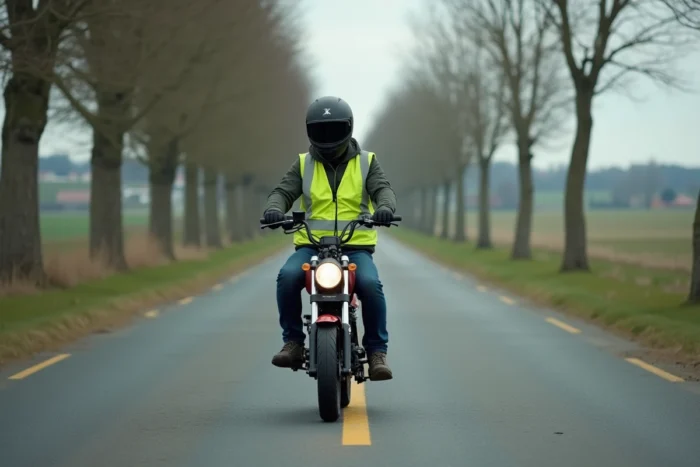
The basic rule is unambiguous: an unapproved vehicle cannot circulate on public roads. This includes roads, sidewalks, bike paths, as well as rural paths open to traffic.
On the ground, feedback varies on this specific point: some dirt paths in agricultural areas seem isolated, but they remain legally classified as roads open to traffic. The gendarmerie regularly reminds this distinction during prevention campaigns against motorized rodeos.
Where Can You Ride Practically
- On a closed private land that you own or for which you have written permission from the owner, provided that this land is not open to public traffic.
- On circuits or motocross tracks affiliated with a federation (FFM, UFOLEP), which have their own insurance and supervision.
- On private spaces dedicated to motorized leisure, with active civil liability coverage.
Riding in a field, on an unfenced private parking lot, or in a public wood exposes you to a fine and seizure of the vehicle. Confusing “private land” with “a quiet place where no one passes” can be costly.
Civil Liability Insurance: Mandatory Even on Private Land
This is the point that most parents discover too late. Civil liability insurance is mandatory for any motorized land vehicle, including unapproved ones, even when used exclusively on private land. The insurance code does not distinguish between a registered vehicle and a mini motocross bike.
In practice, standard home insurance does not cover motorized vehicles. You need to take out a specific policy, often offered by insurers specializing in motorcycles or motorized leisure. The cost remains moderate, but the lack of coverage in case of injury to a third party can expose parents to significant financial liability.
Criminal Responsibility of Parents in Case of Offense
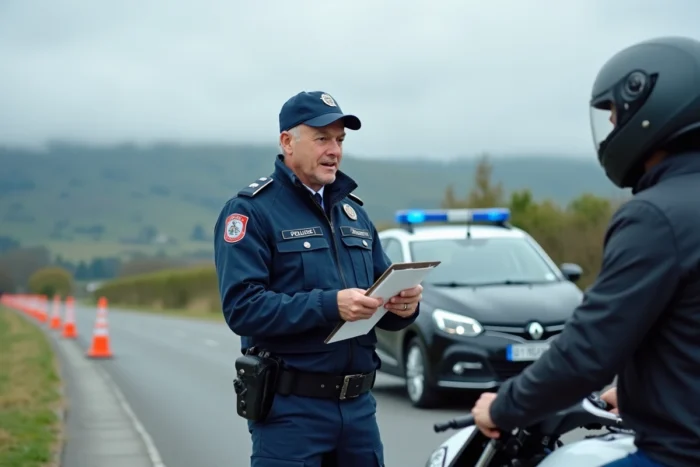
If a child uses a Piwi 80 on public roads, parents can be prosecuted criminally. The sanctions are not limited to fines: confiscation of the vehicle is provided for, and parental responsibility is directly engaged. Law enforcement has had a clear legal framework to intervene since the tightening of measures against urban rodeos, including in rural areas.
A practical detail: even if the child rides “just 50 meters” on a public path to reach private land, this trip is illegal. Transporting the bike in a trailer or utility vehicle to the practice area remains the only compliant option.
Sanctions and Fines for Illegal Circulation of an Unapproved Vehicle
The consequences are not symbolic. Riding on public roads with an unapproved vehicle exposes you to a fine of up to 1,500 euros. In case of repeat offenses, this amount can be doubled.
- Fine for driving an unapproved vehicle on public roads, accompanied by possible immobilization and impoundment.
- Fine for lack of insurance, which constitutes a separate offense with its own penalties.
- Confiscation of the vehicle, pronounced by the court in case of criminal proceedings related to motorized rodeos.
The accumulation of offenses can considerably increase the bill: lack of insurance, circulation on public roads, endangering others if a minor is involved. Each offense is treated separately.
Piwi 80 and Anti-Pollution Standards: Why Yamaha Stopped Production
The Piwi 80 is no longer available new. Yamaha ceased production in the face of anti-pollution standards imposed on two-stroke engines. Rather than developing a four-stroke engine for this children’s range, the brand did not provide a direct successor.
This disappearance has a concrete effect on regulations: spare parts remain available, but any modification to the engine (reprogramming, changing to a non-compliant exhaust) can turn an already unapproved vehicle into a source of additional problems. A non-compliant exhaust worsens the situation in case of a check, even on private land if noise nuisances are observed.
The second-hand market remains very active, with sometimes surprising prices for a children’s bike over a decade old. Before buying, checking the general condition and ensuring that the vehicle has not been modified beyond the original parts remains a basic precaution, both for the child’s safety and for regulatory compliance.